Your website is your business's most important digital asset. It works around the clock, introduces your brand to new customers, and drives enquiries while you sleep. But without regular care, even the best-built site can quietly deteriorate — becoming slow, insecure, or outdated in ways that push visitors away and hurt your search rankings.
In 2026, UK small businesses face a more demanding digital environment than ever. Google updates its ranking systems continuously. Cyber threats evolve. User expectations for speed and mobile experience keep rising. Website maintenance services exist to ensure your site stays ahead — secure, fast, and ready to convert — without requiring you to become a technical expert yourself.
This guide explains exactly what website maintenance involves, why it matters for UK businesses, what it typically costs, and how to find the right provider for ongoing website support and maintenance.
What Are Website Maintenance Services?
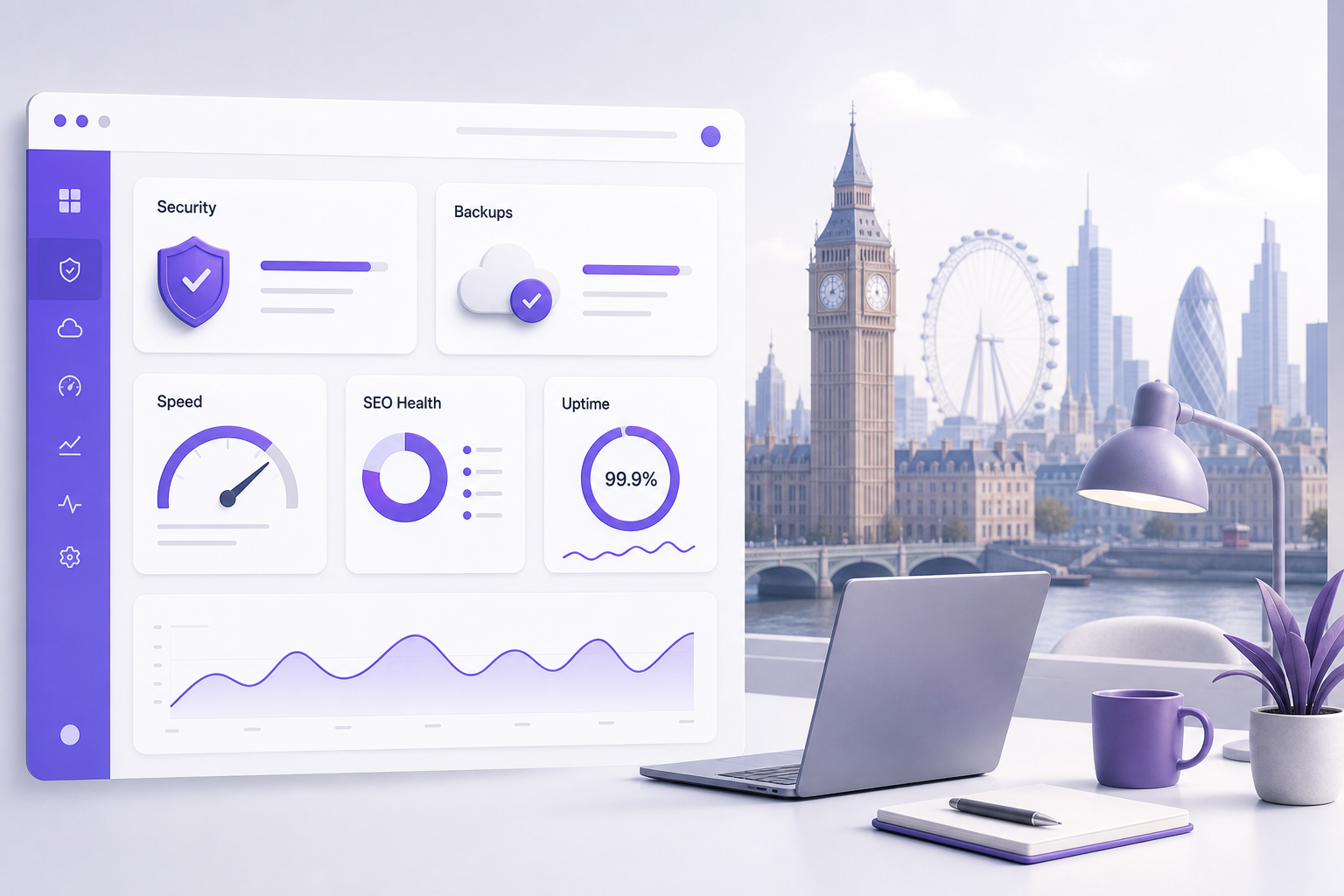
Website maintenance services are ongoing activities that keep a business website secure, up to date, fast, and functioning correctly. They cover technical health (security patches, backups, uptime monitoring), performance (speed, Core Web Vitals), content accuracy (updating text, images, and products), and SEO health (fixing broken links, checking indexability).
Unlike a one-time web design project, website maintenance is a continuous commitment. Think of it like servicing a car: the initial build gets you on the road, but regular checks keep you running safely and efficiently over time.
Why Website Maintenance Is Important in 2026
Small business websites face real and growing risks when left without regular attention. Here is why maintenance matters more than ever this year:
- Security: Cyber attacks targeting small business websites increased significantly in recent years. Outdated plugins, unpatched CMS versions, and weak configurations are common entry points. Regular security updates and monitoring significantly reduce your exposure.
- Speed and Core Web Vitals: Google uses page experience signals — including loading speed, interactivity, and visual stability — as ranking factors. Unmaintained sites gradually become slower, which harms both rankings and user experience.
- SEO health: Broken links, crawl errors, thin or duplicate content, and missing meta data all degrade your search visibility over time. Regular SEO health checks catch these issues before they compound.
- User experience: Outdated content, broken contact forms, or a site that displays poorly on newer mobile devices erodes trust in your brand and reduces enquiries.
- Uptime: Even short periods of downtime can cost sales and damage reputation. Monitoring ensures problems are caught and resolved quickly.
- Content freshness: Search engines reward pages that are kept up to date with accurate, current information. Stale content signals neglect.
- Trust signals: Visitors notice when a website feels current and professional. A poorly maintained site suggests a business that may not be active or reliable.
What Is Included in Website Maintenance Services?
A comprehensive website maintenance plan typically covers the following areas:
- Security updates: Applying patches to CMS platforms, plugins, themes, and server-level software to protect against vulnerabilities.
- Plugin, theme, and CMS updates: Keeping all software components current to maintain compatibility and security.
- Website backups: Creating and storing regular backups so your site can be restored quickly if something goes wrong.
- Speed and performance checks: Testing load times, image compression, caching, and server response to maintain fast page delivery.
- Broken link checks: Identifying and fixing internal and external links that return errors, which harm both users and SEO.
- Content updates: Adding new pages, updating existing text, changing images, and keeping business information accurate.
- SEO health checks: Monitoring indexability, crawl errors, meta data, structured data, and Core Web Vitals.
- Form and functionality testing: Verifying that contact forms, checkout processes, and other interactive elements work correctly.
- Mobile responsiveness checks: Ensuring the site displays correctly across different devices and screen sizes.
- Analytics and tracking checks: Confirming that Google Analytics, conversion tracking, and other tools are recording data accurately.
- Technical support: Providing a point of contact for questions, bug fixes, and unexpected issues as they arise.
Website Maintenance Services Comparison
Different levels of support suit different business needs. The table below gives a general comparison across three tiers of website maintenance:
| Feature | Basic Maintenance | Growth Maintenance | Premium Support |
|---|---|---|---|
| Security checks | Monthly | Bi-weekly | Weekly |
| Website backups | Monthly | Weekly | Daily |
| Speed monitoring | Quarterly | Monthly | Weekly |
| Content updates | Not included | Up to 1 hr/month | Up to 3 hrs/month |
| SEO health checks | Quarterly | Monthly | Monthly |
| Broken link checks | Quarterly | Monthly | Weekly |
| Technical fixes | Emergency only | Included | Priority included |
| Monthly report | Basic summary | Detailed report | Advanced insights |
| Priority support | No | No | Yes |
| Best for | Simple info sites | Growing businesses | E-commerce & high traffic |
This is a general framework. The scope of any maintenance plan should be agreed clearly with your provider based on your specific site, platform, and business requirements.

How Much Do Website Maintenance Services Cost in the UK?
Website maintenance costs in the UK vary widely depending on several factors, and any fixed price quoted without understanding your site should be treated with caution. Key variables include:
- Website size and complexity: A five-page brochure site requires far less maintenance time than a 200-page e-commerce store.
- Platform and technology: WordPress, Shopify, custom-built, and headless sites each have different update requirements and associated costs.
- Update frequency: Monthly, weekly, or continuous maintenance will have different pricing structures.
- Content update needs: If you need regular copy, image, or product updates, this adds to the scope and cost.
- SEO and performance requirements: Sites targeting competitive keywords may require more intensive technical SEO oversight.
- Support response time: Priority support with guaranteed response times is typically priced at a premium.
- Number of integrations: Sites with CRM, booking, payment, or third-party tool integrations need additional care to maintain compatibility.
The right approach is to identify what your site actually needs — security, content, performance, SEO, or support — and find a plan that matches that scope, rather than selecting the cheapest option available.
Website Maintenance vs Website Redesign
A common question from small business owners is whether to invest in ongoing maintenance or a full redesign. The answer depends on the current state of your site.
Maintenance is usually the right choice when: your site has a solid structure and brand, loads reasonably well, is mobile-friendly, and primarily needs upkeep, content updates, and security care. Consistent maintenance can extend the useful life of a well-built site considerably.
A redesign is worth considering when: your site is more than four or five years old, does not display correctly on mobile, uses an outdated platform, fails to convert visitors despite good traffic, or no longer reflects your brand or services accurately. If you need a new business website, explore WebCrux web design services or view web design packages from £499 as a starting point.
In many cases, a refresh (updating the design within an existing structure) sits between the two options and can be a cost-effective middle path.
How to Choose the Right Website Maintenance Provider
When evaluating website maintenance providers in the UK, look for the following:
- Clear scope agreement: The provider should document exactly what is and is not included in your plan before you commit.
- Fast and reliable communication: Delays in responding to technical issues can have real business impact. Ask how support requests are handled and what response times to expect.
- SEO awareness: Your maintenance provider should understand basic SEO principles so that routine updates do not inadvertently harm your rankings.
- Documented backup process: Ask how often backups are taken, where they are stored, and how quickly the site can be restored from a backup.
- Security focus: They should have a clear process for applying security updates, not simply waiting until something breaks.
- Transparent monthly reporting: A brief monthly summary of what was done, what was found, and what was fixed helps you stay informed without needing technical knowledge.
- Experience with business websites: Look for providers who work with businesses similar to yours in size and sector, and who can demonstrate an understanding of your needs.
You can also see all WebCrux services to understand how maintenance fits into a broader digital strategy, or explore AI-powered web solutions if you are interested in combining maintenance with intelligent automation for your site.
WebCrux Website Maintenance for UK Businesses
For UK small businesses looking for reliable website support, the most important thing is choosing a maintenance plan that addresses what your specific site genuinely needs — not an overpromising package that charges for services you will rarely use.
At a minimum, a sensible maintenance plan for a small business website should cover security monitoring and updates, regular backups, speed checks, and a clear support channel for when things go wrong. Adding SEO health checks and periodic content updates brings meaningful additional value as your site matures.
WebCrux offers website maintenance and website support services for UK businesses, working with small businesses and service brands to keep their sites secure, fast, and well-maintained. If your website needs ongoing care, contact WebCrux for website support to discuss what your site needs.
Frequently Asked Questions
What are website maintenance services?
Website maintenance services are ongoing activities that keep a website secure, up to date, fast, and functioning correctly. They typically include security updates, regular backups, speed checks, content updates, broken link audits, and technical support.
Why does my business website need maintenance?
Without regular maintenance, business websites can become vulnerable to security threats, suffer slow loading speeds, develop broken links, fall behind competitors in search rankings, and display outdated information — all of which damage customer trust and reduce enquiries.
How often should a website be maintained?
Most business websites benefit from monthly maintenance at a minimum. High-traffic sites, e-commerce stores, or sites with frequent content changes may require weekly or more regular attention to maintain performance and security.
Does website maintenance help SEO?
Yes. Regular maintenance improves site speed, fixes broken links, resolves technical errors, keeps content current, and maintains proper indexability — all of which are positive ranking signals for search engines including Google.
What is included in a website maintenance plan?
A typical plan includes security monitoring and updates, regular backups, speed and performance checks, content updates, broken link checks, SEO health audits, form testing, mobile responsiveness checks, analytics verification, and technical support. The exact scope depends on the provider and tier chosen.
Can WebCrux update my existing website?
Yes. WebCrux provides website maintenance and support services for UK businesses, including updates to existing websites, security monitoring, performance improvements, and content changes.
Is website maintenance better than a redesign?
Maintenance is better when your site's structure and branding are sound but need upkeep. A redesign is worth considering when the site is outdated, not mobile-friendly, failing to convert visitors, or no longer reflects your business. View web design packages if a new site may be the right step.
How do I contact WebCrux for website support?
You can contact WebCrux via the contact form on the homepage, or email Webcrux.co.uk@gmail.com to discuss your website maintenance requirements.
Conclusion
Website maintenance services are not a luxury — for any UK small business that relies on its website to attract and convert customers, they are a practical necessity. Regular security updates, backups, speed monitoring, and SEO health checks protect your investment, preserve your rankings, and keep your site performing well for the people who visit it.
The right maintenance plan will depend on your site's size, platform, and how actively you use it. Start by identifying your highest-priority risks — usually security and backups — and build from there.
If you are ready to put your website in good hands, explore WebCrux website maintenance services or get in touch to discuss what your site needs.