For a UK small business, your website is often the first — and most important — digital touchpoint a potential customer has with your brand. But a well-designed website that nobody can find is a wasted investment. That is where search engine optimisation comes in.
In 2026, SEO for small business websites is no longer a luxury or something you can defer until later. Google processes billions of searches every day, and the businesses that appear in results are the ones that have invested in the right foundations. The good news is that most of what makes a website rank well is achievable without an enterprise budget — it requires clarity, consistency, and the right technical setup.
This guide covers everything a UK small business needs to know about improving website SEO in 2026: from technical foundations and content strategy to schema markup, backlinks, and the emerging importance of AI search visibility. If you would rather have a professional team handle this, explore WebCrux SEO services or view SEO-friendly web design packages from £499.
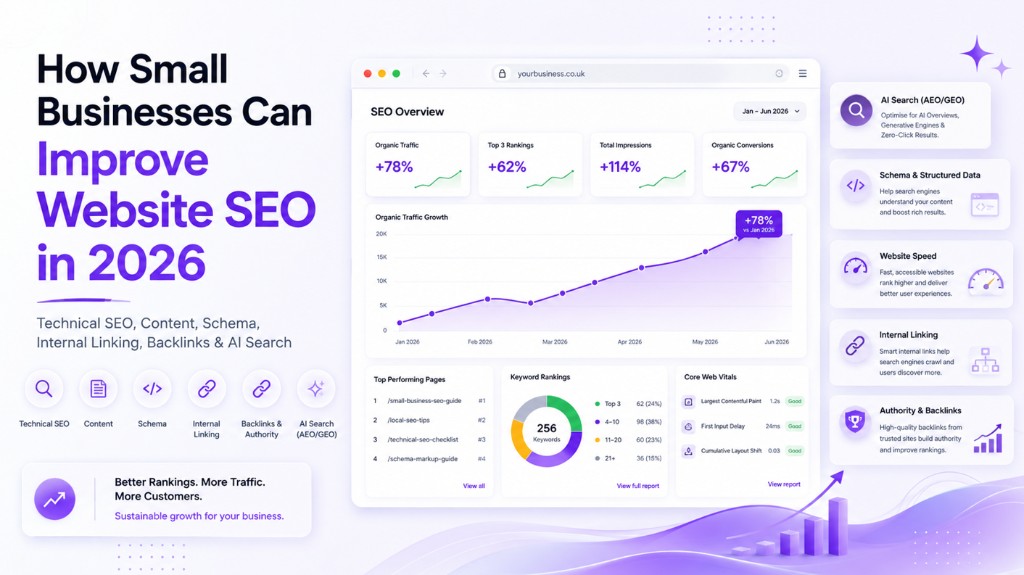
What Small Business Website SEO Means in 2026
Website SEO is the practice of making your site visible, trustworthy, and useful to both search engines and the people who use them. In 2026, Google's ranking systems evaluate hundreds of signals, but the ones that matter most for small businesses remain consistent: technical health, relevant helpful content, page experience, and credibility signals including backlinks and structured data.
The landscape has shifted in one important way: AI-powered search tools (Google AI Overviews, ChatGPT, Perplexity) are now a significant discovery channel alongside traditional search results. This means small businesses need to optimise not just for ranking in blue links, but for being cited by AI systems — a discipline known as AEO (Answer Engine Optimisation) and GEO (Generative Engine Optimisation).
The businesses that perform best in 2026 are those that treat their website as a living, maintained asset — regularly updated, technically sound, fast-loading, and rich with content that genuinely serves their audience. For more on keeping your site in good shape after launch, read our website maintenance services UK guide.
Basic SEO vs Growth SEO vs Authority SEO
Not all SEO investment looks the same. The table below compares three tiers of website SEO activity so you can understand where you are and where you should be targeting:
| Activity | Basic SEO | Growth SEO | Authority SEO |
|---|---|---|---|
| Page titles & meta descriptions | Yes | Yes — keyword-targeted | Yes — A/B tested |
| Mobile-friendly design | Yes | Yes | Yes |
| Clean URL structure | Yes | Yes | Yes |
| Core Web Vitals optimisation | Basic | Measured & improved | Continuous monitoring |
| Keyword-targeted content | No | Pillar + cluster pages | Full content calendar |
| Schema / structured data | No | Organization, FAQPage | Full schema graph |
| Internal linking strategy | Ad hoc | Planned structure | Audited & optimised |
| Backlink building | No | Directories + outreach | Digital PR + partnerships |
| AEO / AI search optimisation | No | Partial | Full implementation |
| Monthly reporting | No | Yes | Advanced with attribution |
| Best for | New or simple sites | Growing businesses | Competitive markets |
Most UK small businesses should be targeting Growth SEO as a baseline — it is where the meaningful ranking improvements happen without requiring an enterprise content team or budget.
Technical SEO Checklist for Small Business Websites
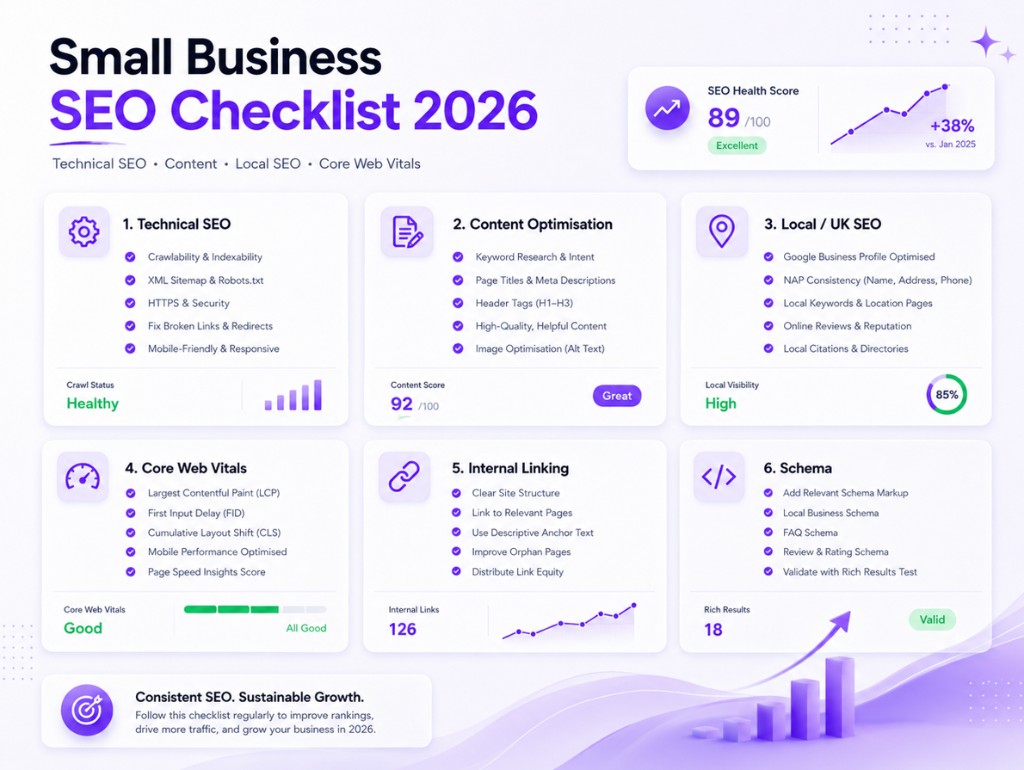
Technical SEO ensures that search engines can discover, crawl, and index your site correctly. Problems here are often invisible to the business owner but very visible to Google. Run through this checklist and fix anything that applies to your site:
- Canonical URLs: Every page should have a single, consistent URL. Use canonical tags and 301 redirects to eliminate duplicate versions (e.g. with and without trailing slashes, or with and without www).
- HTTPS: Every page should be served over HTTPS. Insecure HTTP sites are flagged by browsers and penalised by Google.
- XML sitemap: Submit a clean sitemap to Google Search Central via Google Search Console. Only include canonical, indexable URLs — no redirects, no noindex pages, no trailing-slash duplicates.
- Robots.txt: Confirm your robots.txt is not accidentally blocking important pages. Check it at yoursite.com/robots.txt.
- Indexability: Use Google Search Console to confirm key pages are indexed. Fix any Crawled — Currently Not Indexed issues.
- Redirect chains: Internal links should point to final destination URLs, not through chains of redirects.
- Broken links: Fix any internal 404 errors. These waste crawl budget and damage user experience.
- Mobile-first rendering: Google primarily uses your mobile version to rank your site. Test pages with Google's mobile-friendly test.
- Structured data (schema): At minimum, implement Organization, WebPage and BreadcrumbList schema. More on this below.
Content SEO Checklist
Content is how you communicate your expertise and relevance to both search engines and real users. Google's helpful content system rewards pages that genuinely serve search intent — not pages that simply stuff keywords:
- Page title tags: Every page should have a unique, descriptive title tag (under 60 characters) that naturally includes the primary keyword.
- Meta descriptions: Every page should have a unique meta description (under 160 characters) that summarises the page and encourages clicks. Missing meta descriptions leave Google to auto-generate them, often poorly.
- H1 and heading structure: Each page should have exactly one H1 containing the primary keyword. Use H2s and H3s to organise supporting sections logically.
- Keyword research: Identify what your target customers actually search for. Target informational queries (guides, how-tos) as well as transactional queries (services, packages, prices).
- Content depth: Service pages and articles should answer the full question a visitor might have — not just mention a topic superficially. Thin pages struggle to rank.
- Image alt text: Every image should have descriptive alt text that describes the image content, both for accessibility and SEO. Missing alt text is one of the most common audit warnings.
- Content freshness: Update service pages and articles regularly to reflect current pricing, processes, and information. Stale content signals neglect.
- FAQ content: Including FAQ sections using
FAQPageschema dramatically improves eligibility for rich results and AEO answer boxes.
Local and UK SEO Checklist
For a UK small business, local and national relevance signals are often the fastest route to meaningful visibility. These are the key actions:
- Google Business Profile: Claim and fully complete your Google Business Profile. This is the single most important local SEO action. Include correct NAP (Name, Address, Phone), categories, opening hours, photos, and a description linking to your website.
- UK-specific content: Use British English, reference UK cities or regions where relevant, and include pricing in GBP. Google uses language and geographic signals to determine relevance for UK searches.
- LocalBusiness schema: Add LocalBusiness structured data to your site if you serve a specific geographic area, including your address, phone number, and service area.
- Consistent NAP across directories: Ensure your business name, address, and phone number are identical across Google Business Profile, your website, and any directory listings. Inconsistencies confuse search engines.
- UK business directories: List your business on reputable UK directories — Yell, FreeIndex, Checkatrade (if applicable), and Yelp UK. These provide citations that reinforce your local presence.
- Location pages: If you serve multiple areas, create dedicated, substantive location pages rather than duplicating generic content.
Website Speed and Core Web Vitals
Google uses page experience signals — including speed, visual stability, and interactivity — as ranking factors. These are measured through Core Web Vitals: three specific metrics that Google considers the most important aspects of page experience:
- Largest Contentful Paint (LCP): How quickly the largest visible element loads. Target: under 2.5 seconds.
- Cumulative Layout Shift (CLS): How much the page layout shifts unexpectedly while loading. Target: under 0.1.
- Interaction to Next Paint (INP): How quickly the page responds to user input. Target: under 200ms.
For small business websites, the most common Core Web Vitals problems are unoptimised images (causing slow LCP), fonts loading without size reservations (causing CLS), and heavy JavaScript (causing slow INP). Fixing these — through image compression, proper font-display settings, and minimal third-party scripts — typically produces immediate improvements visible in Google Search Console.
If your current site has chronic performance problems and is built on an outdated platform, it may be more cost-effective to rebuild it on a modern stack. Explore SEO-friendly web design services or view web design packages that include performance-conscious builds from the start.
Schema and Structured Data
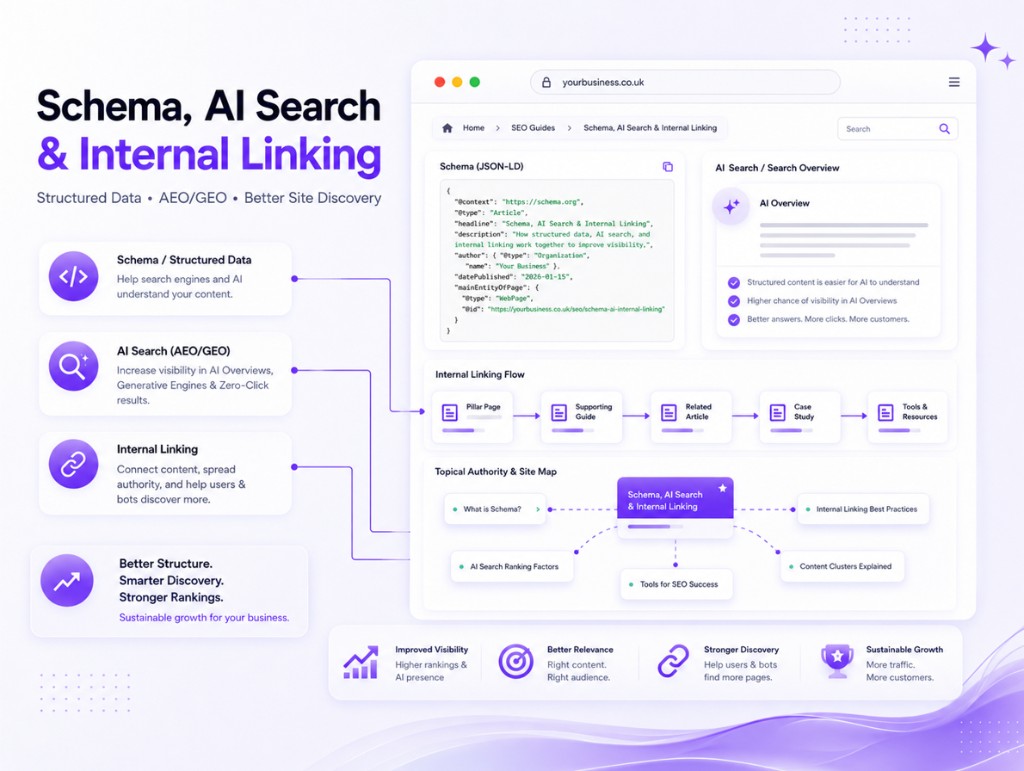
Structured data (schema markup) is code you add to your pages to help search engines understand your content and enable rich results in search. The Schema.org structured data vocabulary defines the types and properties you can use, and Google's own structured data guidelines explain which types are supported for rich results.
For UK small businesses, the minimum recommended schema implementation is:
- Organization: Your business name, logo, URL, social profiles, and contact information.
- WebPage / WebSite: Page-level metadata for Google's sitelinks search box and crawl understanding.
- BreadcrumbList: Navigation context that appears in search results as a structured path.
- FAQPage: Enables FAQ rich results for pages with question-and-answer sections — directly increases answer box visibility.
- LocalBusiness: If you serve a specific area, adds address, phone, and opening hours to your knowledge panel.
- BlogPosting / Article: For articles and guides, adds publication date, author, and content type context.
Always implement schema as JSON-LD in the page <head> and validate with Google's Rich Results Test. Never duplicate schema via both JSON-LD and HTML microdata on the same page.
Internal Linking Strategy
Internal linking — connecting your own pages to each other with descriptive anchor text — distributes authority across your site and helps search engines understand which pages are most important. For small business websites, a clear internal linking hierarchy significantly improves crawl efficiency and keyword relevance signals.
Practical internal linking rules for small business websites:
- Link from high-traffic, high-authority pages (homepage, service hub) to priority money pages (service pages, pricing pages).
- Use descriptive anchor text — "view web design packages" not "click here" or "learn more".
- Add contextual links within article bodies to relevant service pages. Articles are an excellent source of topical authority passed through to commercial pages.
- Avoid orphan pages — every important page should receive at least one internal link from elsewhere on the site.
- Legal pages (privacy policy, terms) should only appear in the footer legal bar, not in Quick Links or navigation that passes excessive link equity to non-commercial pages.
- Review your internal link distribution regularly using Google Search Console's internal links report or a crawl tool.
Backlinks and Authority Building for UK Small Businesses
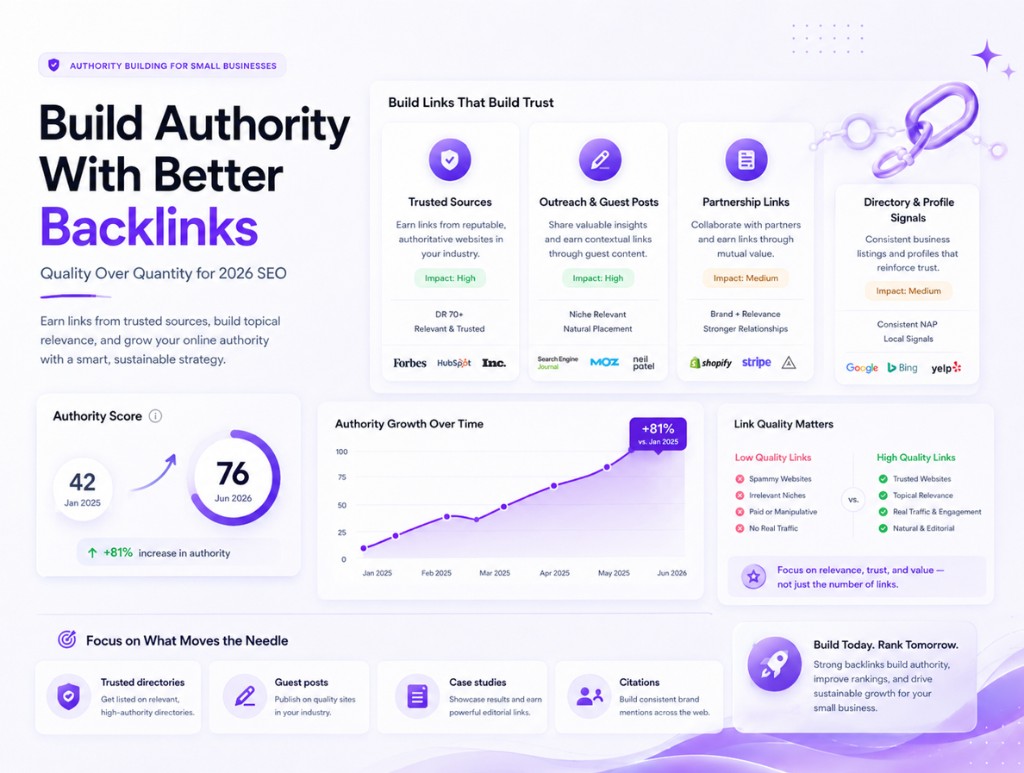
Backlinks — links from other websites to yours — remain one of the most important ranking signals Google uses. An authority score of 2 (as reported by tools like Semrush) with fewer than 10 referring domains indicates that authority building should be a priority for any small business seeking competitive rankings.
The only safe and durable approach to building backlinks is to earn them through genuinely useful content, honest business listings, and real relationships. Paid link schemes and private blog networks remain explicitly against Google's spam policies and can result in manual penalties. Here are the strategies that actually work for UK small businesses:
Safe backlink strategies for UK small businesses
- Business directories: Submit to reputable UK directories — Google Business Profile (essential), Yelp UK, Yell.com, FreeIndex, Checkatrade, and industry-specific directories relevant to your sector. These provide legitimate, stable citations.
- Guest posts and editorial contributions: Write genuinely useful articles for industry publications, local business associations, or trade bodies. A single editorial link from a respected publication is worth more than dozens of directory links.
- Partner and supplier websites: Ask complementary businesses you work with (designers, accountants, suppliers) to mention you on their site, case study pages, or partner pages, and do the same for them.
- Case studies and client work: Publish detailed case studies of your work. When clients or partners reference the work you did together, they often link back to your site.
- Local business profiles: Claim your profiles on local chamber of commerce sites, local authority supplier directories, and any relevant trade association member directories.
- Guides and resources worth citing: This guide is an example. Practical, specific resources that answer questions no one else has answered well are the most linkable assets a small business can create. Two original guides per year, done properly, outperform ten thin blog posts.
- Social profiles with website links: Ensure your LinkedIn company page, Facebook business page, Instagram, X/Twitter, and any relevant industry platforms all link to your website with consistent NAP. These are typically nofollow but signal entity consistency to Google.
- Founder and company profiles: A LinkedIn founder profile with a website link, an about.me page, or a Crunchbase profile all contribute to entity recognition and provide additional crawlable references to your domain.
- Press and local media: For newsworthy announcements — a significant project win, a new service, a community initiative — a brief press release to local media or industry newsletters can earn editorial coverage with genuine links.
The key principle is: create things worth linking to, and then tell the right people about them. Good content, a credible business, and honest outreach will compound steadily over 12 to 24 months into a meaningful backlink profile that no algorithm update will penalise.
AI Search, AEO, and GEO Optimisation
In 2026, AI-powered tools — Google AI Overviews, ChatGPT, Perplexity, Microsoft Copilot — are answering millions of questions that previously went to traditional search results. For small businesses, this creates a new requirement: ensuring your content is structured so that AI systems can extract, cite, and recommend it.
This discipline is called Answer Engine Optimisation (AEO) and Generative Engine Optimisation (GEO). The good news is that the practices that make a site good for AEO are largely the same as what makes it good for traditional SEO, with some additional emphases:
- Answer-first content structure: State the direct answer to the question within the first two sentences of a section, then expand with context. AI systems scan for concise, confident answers.
- FAQ sections: FAQPage schema with specific questions and clean, factual answers is the clearest signal to AI systems that your page contains authoritative answers. Include FAQs on every key page.
- Entity clarity: Ensure your brand name, location, services, and category are clearly stated on your homepage and About page. AI systems build entity graphs — if they are uncertain who or what your business is, they will not cite you.
- Structured data breadth: The fuller your schema graph (Organization, Service, FAQPage, Article, BreadcrumbList), the more context AI systems have when evaluating your site for citations.
- Factual, specific content: AI systems prefer content with concrete specifics (prices, processes, timescales, locations) over vague generalist claims. If you offer web design packages from £499, say so explicitly.
- Credibility signals: Social media profiles with consistent information, Google Business Profile, and external citations all contribute to entity confidence for AI systems.
- AI web solutions: If you want to embed AI features — chatbots, intelligent search, or automation — into your own website, explore WebCrux AI web solutions.
Final SEO Recommendations for UK Small Businesses
If you are starting from an authority score of 2 and fewer than 10 organic keywords, here is a prioritised action plan for the next six months:
- Month 1 — Technical foundations: Fix all crawl errors and redirect chains. Confirm canonical URLs are clean. Submit a correct sitemap to Google Search Console. Ensure all pages have unique titles and meta descriptions. Fix missing image alt text.
- Month 1–2 — Schema implementation: Add a full JSON-LD schema graph to every page (Organization, WebPage, BreadcrumbList, FAQPage where relevant). Validate with the Rich Results Test.
- Month 2–3 — Core Web Vitals: Run a Lighthouse audit on key pages. Compress and properly size images. Fix layout shift issues. Remove or defer heavy scripts. Target green scores on LCP, CLS, and INP.
- Month 2–4 — Content: Publish two substantive articles (1,000+ words) targeting questions your customers actually ask. Add FAQ sections with schema to all key service and landing pages. Update all service page content to be specific and current.
- Month 3–6 — Backlinks: Complete all reputable directory submissions. Identify three to five partner, supplier, or complementary businesses for mutual mentions. Pitch one guest article to a relevant industry publication or local media outlet.
- Ongoing — Maintenance and monitoring: Review Google Search Console weekly. Run monthly SEO health checks — broken links, crawl errors, indexation issues. Keep content fresh. For ongoing support, consider WebCrux website maintenance services which include SEO health checks as standard.
If you need a new website built with all of these foundations in place from day one, view web design packages that include SEO-ready structure, clean canonical URLs, schema markup, and performance optimisation. Or if you want a professional team to manage your SEO ongoing, improve website visibility with WebCrux SEO services.
Frequently Asked Questions
What is website SEO for small businesses?
Website SEO for small businesses is the practice of optimising a website so it appears prominently in search engine results for queries relevant to that business. It covers technical health, on-page content, local signals, backlinks and page experience factors like Core Web Vitals.
How long does SEO take to show results for a small business?
Most small businesses see meaningful movement in search rankings within three to six months of consistent SEO work, though competitive markets may take longer. Technical fixes and Core Web Vitals improvements can produce quicker gains, while content and link-building efforts compound over time.
What is the most important SEO factor for a small business website in 2026?
In 2026, the most important factors are a combination of technical health (Core Web Vitals, crawlability, mobile-friendliness), genuinely helpful content that answers real questions, and a credible backlink profile. No single factor dominates — Google evaluates signals holistically.
Do I need schema markup on my small business website?
Yes. Schema markup (structured data) helps search engines understand your content and can enable rich results like FAQs and business information in search results. At minimum, small businesses should implement Organization, LocalBusiness, WebPage and BreadcrumbList schema.
What is AEO and why does it matter for small businesses in 2026?
AEO stands for Answer Engine Optimisation — structuring content so AI assistants and search engines select it as the definitive answer to specific questions. With AI Overviews and tools like ChatGPT becoming primary research channels, small businesses that structure content clearly are more likely to be cited and recommended.
How do I get more backlinks for my small business website?
Safe backlink strategies for UK small businesses include listing in reputable business directories (Google Business Profile, Yell, FreeIndex), creating genuinely useful guides that others cite, publishing case studies, partnering with complementary local businesses, and earning coverage in local press or industry publications.
Can WebCrux help improve my business website SEO?
Yes. WebCrux provides SEO services for UK small businesses covering technical audits, on-page optimisation, content strategy, Core Web Vitals improvements, and schema implementation. We also build SEO-friendly websites from £499 via our web design packages.
What is the difference between basic SEO and growth SEO?
Basic SEO covers the foundations: correct titles, meta descriptions, mobile-friendly design, clean URLs and indexability. Growth SEO adds content strategy, keyword targeting, internal linking, schema, Core Web Vitals optimisation and structured backlink building. Authority SEO further adds digital PR, advanced structured data and AI-search optimisation.
Conclusion
For UK small businesses, website SEO in 2026 is not optional — it is the foundation of sustainable online growth. The good news is that most of the ranking improvements available to you do not require large budgets. They require the right technical setup, clear and helpful content, a logical internal structure, and steady accumulation of credibility through backlinks and schema.
Start with the foundations: fix technical errors, write descriptive titles and meta descriptions for every page, add schema markup, and optimise your Core Web Vitals. Then layer in content, local SEO, and backlink-building over the following months. Treat your website as an asset that requires ongoing maintenance — not a one-time project.
If you need a website built with all of this in place from day one, view WebCrux web design packages. If you want an expert team to manage your SEO, explore WebCrux SEO services. For ongoing website care that includes SEO health checks, see website maintenance services. And if you want to future-proof your site with AI capabilities, explore AI-powered web solutions.
Trusted resources for small business website owners
These official references underpin the guidance in this article — useful for anyone who wants to understand the standards behind effective small business SEO: